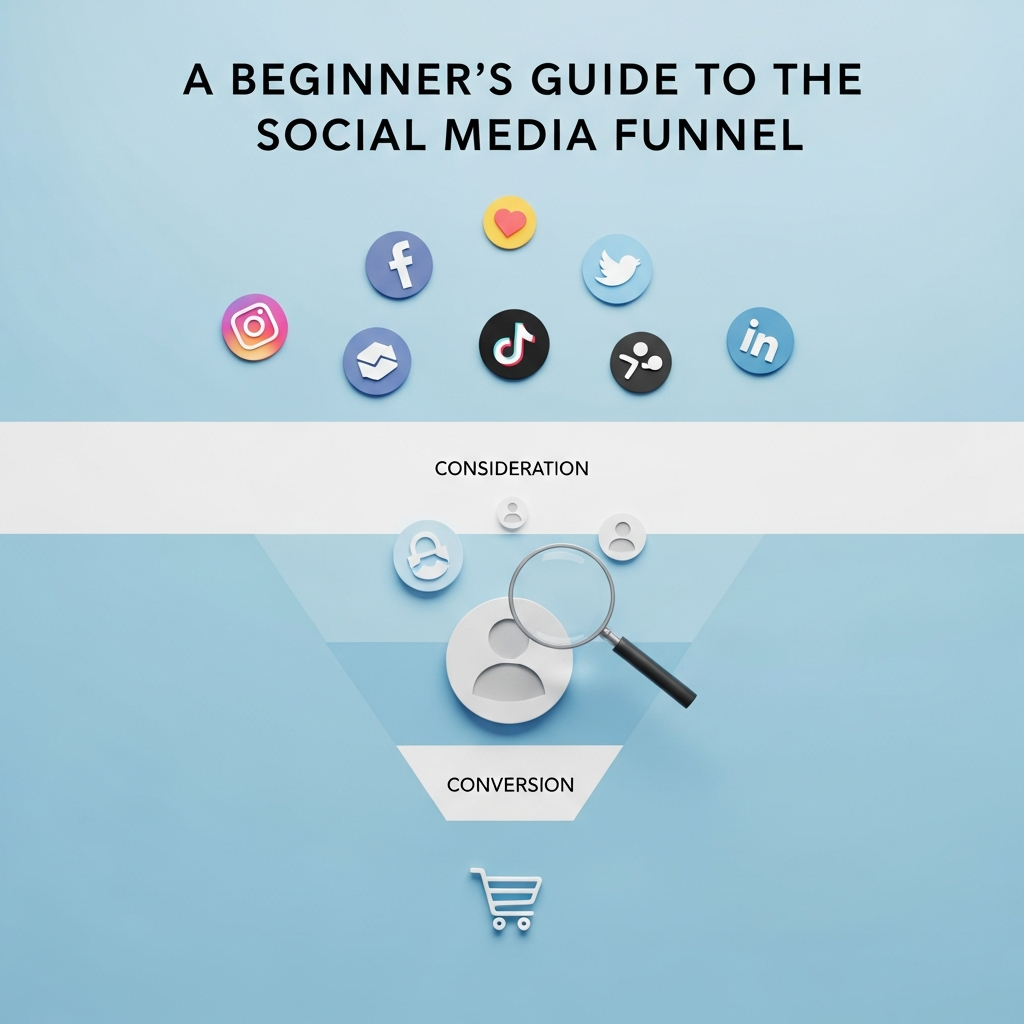
A Beginner’s Guide to the Social Media Funnel
TL;DR
A social media funnel maps your customer's journey from stranger to loyal buyer, giving every post a clear purpose at each stage.
- Match your content to a funnel stage: awareness, interest, decision, action, or loyalty.
- Warm people up with helpful posts before asking them to buy.
- Track where people drop off so you can fix the one weak spot in your funnel.
What Is a Social Media Funnel?
A social media funnel is a simple way to picture your customer’s journey. It starts with strangers and ends with loyal buyers. Each stage moves people a little closer.
Think of it as a path, not a single post. Someone discovers you, then learns to trust you. Ultimately, they buy from you.
The word funnel just means narrowing. Many people see your content at the top. Fewer stick around. Ultimately, the ones who do become customers.
You do not need a marketing degree to understand this. In fact, you already do it in person. A social media funnel is the online version of that.
Rewriting the same post for every channel eats your week. AutoMarketer AI adapts it and posts on autopilot.
Get Started Free →Once you see your posts this way, everything gets clearer. As a result, you stop posting randomly. You start posting with a purpose.
The Stages of a Social Media Funnel
Most funnels have a few clear stages. The top is awareness, where people first find you. The middle builds interest and trust. The bottom drives the sale.
Some people add a stage after the sale too. That is loyalty, where happy customers come back. They also tell their friends about you.
Each stage needs a different kind of content. You would not pitch a sale to someone who just met you. You warm them up first.
Here are the main stages of a social media funnel:
- Awareness: helpful or fun posts that introduce your brand.
- Interest: content that shows what you do and why it matters.
- Decision: posts that highlight your products or services.
- Action: clear calls that ask people to buy or sign up.
- Loyalty: follow-up content that keeps customers close.
Knowing these stages helps you plan. You can ask which stage a post serves. As a result, that small habit makes your marketing stronger.
Why Small Businesses Need a Social Media Funnel
Big brands have huge teams and budgets. You probably do not. However, a social media funnel helps you compete anyway.
It keeps you from wasting effort. Random posts rarely lead to sales. In contrast, a funnel gives every post a job to do.
It also builds trust over time. People rarely buy on the first visit. Your funnel earns their confidence step by step.
A funnel makes your results easier to read. You can see where people drop off. Then you fix that one weak spot.
Best of all, it saves time. When you know your plan, you stop guessing. Furthermore, you spend fewer hours wondering what to post.
Creating Content for Each Funnel Stage
Top-of-funnel content should be easy to enjoy. Share tips, stories, or behind-the-scenes moments. Ultimately, the goal is to get noticed, not to sell.
Middle-of-funnel content goes a little deeper. For example, show how you solve real problems. Answer common questions your customers ask.
Bottom-of-funnel content asks for action. Highlight a product. Share a customer review. Ultimately, invite people to take the next step.
You do not need to write all of this alone. AutoMarketer AI writes social posts in your business voice. Furthermore, it posts to Facebook, Instagram, and X for you.
Here are simple content ideas for each part of your social media funnel:
- Awareness: quick tips, relatable stories, and fun questions.
- Interest: how-to posts and honest looks at your work.
- Decision: product highlights and drafted responses to reviews.
- Action: clear invitations to buy, sign up, or message you.
Tools That Make Your Funnel Easier
Consistency is the hard part of any funnel. Life gets busy and posting slips. However, the right tools keep you on track.
AutoMarketer AI schedules your posts for the date and time you choose. It can also pick a strong time of day for each channel. That runs quietly in the background.
You stay in control the whole way. Review and approve every post before it goes out. Or switch to autopilot once you trust the results.
Your funnel can reach beyond social too. For example, AutoMarketer AI writes blog posts and optimizes them for search. It can send a weekly newsletter built from your recent posts.
You can even repurpose one post into many formats. Turn a blog into social posts, an email, and video scripts. As a result, that feeds every stage of your social media funnel at once.
Building Your First Social Media Funnel
Start small and keep it simple. Pick one product or service to promote. Build your funnel around that single goal.
Sketch out a few posts for each stage. Make some for awareness. Make a couple for interest and a couple for action.
Then set a steady posting rhythm. Even a few posts a week builds momentum. Furthermore, let your tools handle the scheduling and timing.
Watch what happens and learn. See which posts get likes and comments. Ultimately, use those clues to shape your next batch of content.
Your first social media funnel will not be perfect. That is fine. You improve it as you go, one small step at a time.
Ready to build a social media funnel without spending hours each day? AutoMarketer AI can write, schedule, and post your content for you. Therefore, get in touch today and let us help your small business grow.
Frequently Asked Questions
What is a social media marketing funnel?
A social media funnel is a simple way to picture your customer's journey, starting with strangers and ending with loyal buyers. Each stage moves people a little closer to becoming a customer. It helps you stop posting randomly and start posting with a purpose.
What are the main stages of a social media funnel?
Most funnels have a few clear stages: awareness, where people first find you, interest, which builds trust, decision, which highlights your products, and action, which asks people to buy or sign up. Some people add a loyalty stage where happy customers come back and tell their friends. Each stage needs a different kind of content.
Why do small businesses need a social media funnel?
A funnel helps small businesses compete even without huge teams or budgets by giving every post a job to do. It builds trust over time and makes your results easier to read, so you can see where people drop off and fix that weak spot. Best of all, it saves time because you stop guessing what to post.
What kind of content works for each funnel stage?
Top-of-funnel content should be easy to enjoy, like tips, stories, or behind-the-scenes moments to get noticed. Middle-of-funnel content goes deeper to show how you solve real problems and answer common questions. Bottom-of-funnel content asks for action by highlighting a product, sharing a customer review, or inviting the next step.
Can AutoMarketer AI help me create content for my funnel?
Yes, AutoMarketer AI writes social posts in your business's voice and can generate images for your posts using AI. You can review and approve every post before it goes out, or switch to autopilot once you have approved a streak of posts. It also lets you choose which AI writes your content.
Which social media platforms can AutoMarketer AI post to?
AutoMarketer AI posts to Facebook, Instagram, and X (Twitter). You can schedule posts to the date and time you choose, or let it automatically schedule each post to a strong time of day for its channel. It can also repurpose a published post into formats like TikTok and video scripts as text, though it does not post to TikTok.
Leave a Comment
Your email will not be published or shared. We use it only to follow up if needed.